Fibre optic cable carries data as pulses of light through a strand of glass thinner than a human hair. It goes further and faster than copper, and electrical interference does not affect it. But there is more than one kind, and the letters on the jacket matter.
Single-mode: for distance
Single-mode fibre has a tiny glass core, so the light travels in one straight path. That means very little signal is lost, and it can run for kilometres. It is used between buildings, up risers and for links to the outside world.
You will see it marked OS2, and the jacket is usually yellow.
Multimode: for inside the building
Multimode fibre has a wider core, so the light bounces along in many paths. It is cheaper to connect up, but the signal spreads out over distance, so it is used for shorter runs: inside a building or across a data hall.
| Type | Usual colour | Typical 10 Gb/s reach |
|---|---|---|
| OM3 | Aqua | Up to 300 m |
| OM4 | Aqua, or violet in some systems | Up to 400 m |
| OS2 (single-mode) | Yellow | Up to 10 km |
Higher speeds such as 40 or 100 Gb/s have a shorter reach on multimode, which is why the design has to be checked against the equipment that will be plugged in.
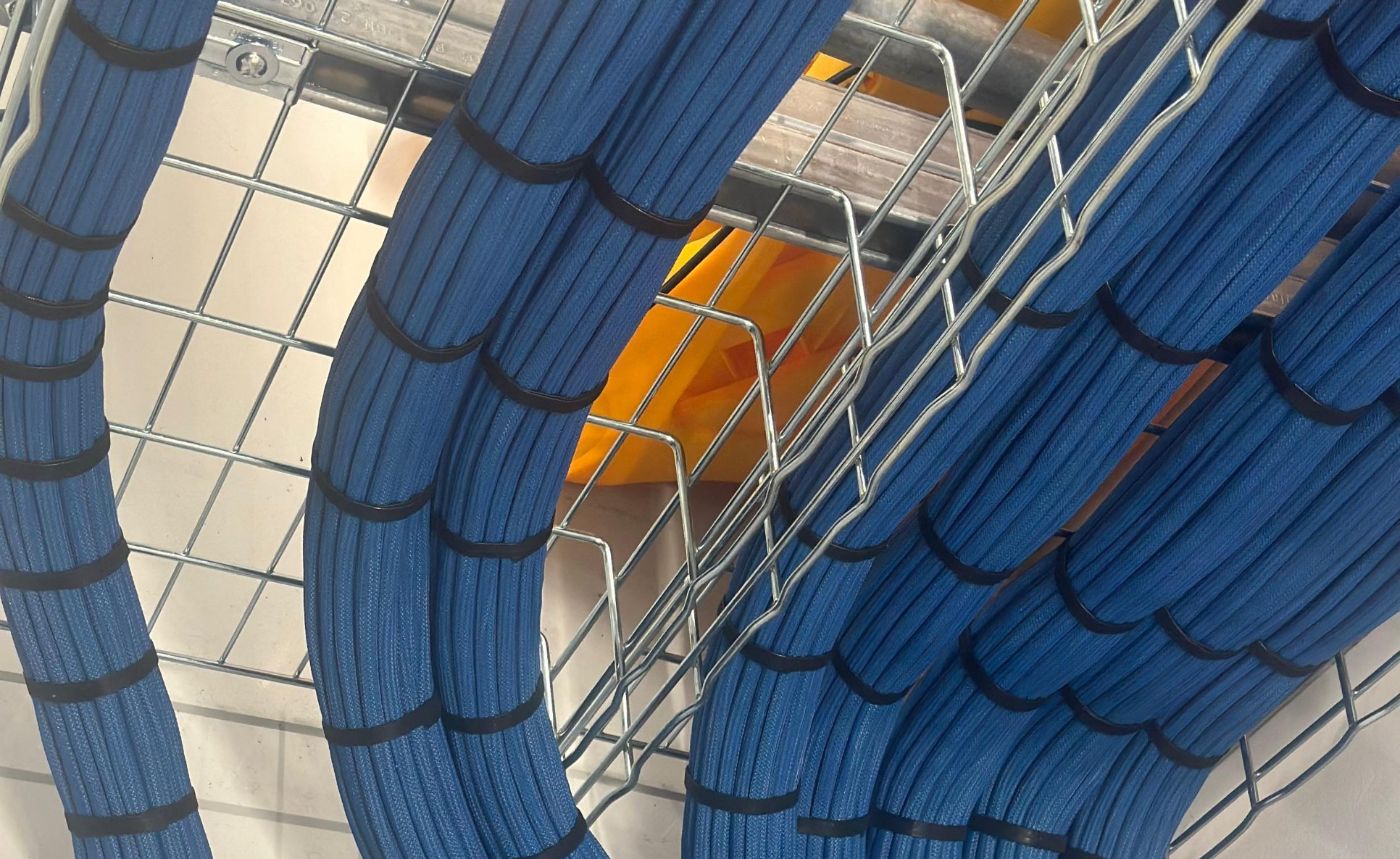
So what is InfiniBand?
InfiniBand is not a type of glass. It is a networking technology built for speed and very low delay, used in supercomputers and the server clusters behind artificial intelligence. Thousands of servers have to talk to each other at once, so the cabling between them is dense and carefully planned.
The cables are often fibre, with the optics built into the plug at each end, and sometimes short copper cables for links inside a rack. What matters for the installer is the same as any fibre job: correct routing, gentle bends, neat dressing and every link accounted for.
Why bends matter: bend a fibre too tightly and light leaks out of the glass. The link may still work, but with less margin, and it can fail later. Neat, gentle loom dressing is not just for looks.
How fibre gets joined
Fibre is joined by fusion splicing: the two glass ends are lined up under a microscope and welded with an electric arc. Done well, the join loses almost no light. Every spliced link is then tested for loss, and the results go in the handover pack.
Want to know more? See our fibre and splicing service or the cable guide.